We help you decide what to cut
If you're a non-technical founder with an idea and a budget, this is exactly what you need most: someone to tell you what doesn't belong in v1.
Services/Product Development/MVP App Development
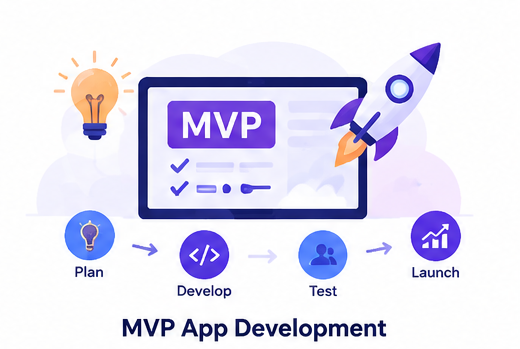
The real risk with an MVP app development project isn't the build, it's shipping the wrong version one. We combine MVP product development judgment with hands-on engineering, so your MVP proves the business, not just the tech.
3–4 weeks
Typical MVP timeframe
Direct access
You work with founders, not account managers
Fixed scope
Agreed price and timeline upfront
100% yours
Full code and IP ownership
Quick answer
MVP app development is the process of scoping, designing and building the first working version of a product, with just enough features to test the core idea with real users. It follows the MVP minimum viable product principle, prove the business assumption before committing to the full build, and typically ships in 3–4 weeks once scope is fixed.
You know what you want built. What's harder to know, before any users touch it, is exactly what belongs in version one.
A typical MVP development company builds whatever you specify, even if the spec cuts the wrong features. That gives you an MVP that works but proves nothing, and rebuilding it later costs far more than getting v1 right the first time.
Every MVP development services engagement is organized around what your first users need to do, not a generic technology list.
Rather than a generic feature list, we work through the decisions that determine what v1 should include:
If you're a non-technical founder with an idea and a budget, this is exactly what you need most: someone to tell you what doesn't belong in v1.
Our differentiation isn't only engineering capability, it's the partner mindset behind it.
We think through users, UX, retention and priorities before the build starts.
Startup MVP development sits inside a wider fractional product capability.
No account-manager layer between you and the people actually building your product.
Your MVP is the start of the product's life, not a disposable prototype.
Everything we build belongs to you outright, with no ongoing dependency on us.
“I know the problem. I need someone to help turn it into the right first product.”
Founder with an idea and no spec
“We're still managing too much manually and need a product around our operations.”
Business going digital
“We can build, but nobody owns product direction.”
Funded startup with a technical team
“We have users, but the product isn't working as well as it should.”
Existing product with poor retention
“We need to validate demand before we commit to a full build.”
Team testing a new business line
“We need a working demo to raise or to sell into a first customer.”
Founder preparing to raise or pitch
How it works
Step 1
We pull apart the problem, users and commercial objective behind your MVP.
Step 2
You get a fixed scope, timeline and cost, or a fractional engineering leadership arrangement.
Step 3
Regular contact with senior engineers and working software throughout, not just at the end.
Step 4
You own everything, with the option to continue with engineering leadership or ongoing development.
A common question that gets overlooked before scoping starts is what assumption the MVP actually needs to validate, not just what it needs to include.
Every MVP is a test of something, that people want this, that they'll pay, that the workflow works. Naming that assumption changes what belongs in v1.
A useful MVP defines failure conditions up front, not just success metrics, so a negative result is still a fast, cheap answer.
'Early adopters' isn't specific enough to design for. A named first user changes onboarding, defaults and even the core flow.
Move from MVP into the full product, with the same team that built v1.
Learn moreBring us on as fractional product leadership as the product grows.
Learn moreMove into product marketing, SEO, AEO/GEO, content and campaigns.
Learn moreMVP app development is custom MVP development applied to a specific product idea: the smallest version that can be tested with real users before committing to a full build. It's the standard first step in MVP product development for startups and existing businesses alike, and the value comes from what gets deliberately left out of v1, not just what gets included.
Most MVPs take 3 to 4 weeks once scope is agreed. That timeframe comes out of the product workshop, not a guess.
We start from what the first user needs to do and which single workflow validates the business. Everything else waits until after launch.
Yes. Most founders start with a rough idea rather than a finished spec. The workshop turns that idea into something buildable.
Yes, outright, once the MVP is delivered. No licensing model, no ongoing dependency on us.
There's no fixed number. Cost depends on scope, and scope is set in the free workshop before you commit to anything, so you get a fixed price and timeline.
Yes. We can review what exists, identify what's worth keeping, and scope the MVP work around it rather than starting from zero.
Run with it yourself, continue building with us, add fractional product leadership, or move into product marketing and growth.